Travel Guide · Updated August 26, 2026 · 9 min read
Where Do You Sleep? Your Guide to Overnight Camper Stays in Greece
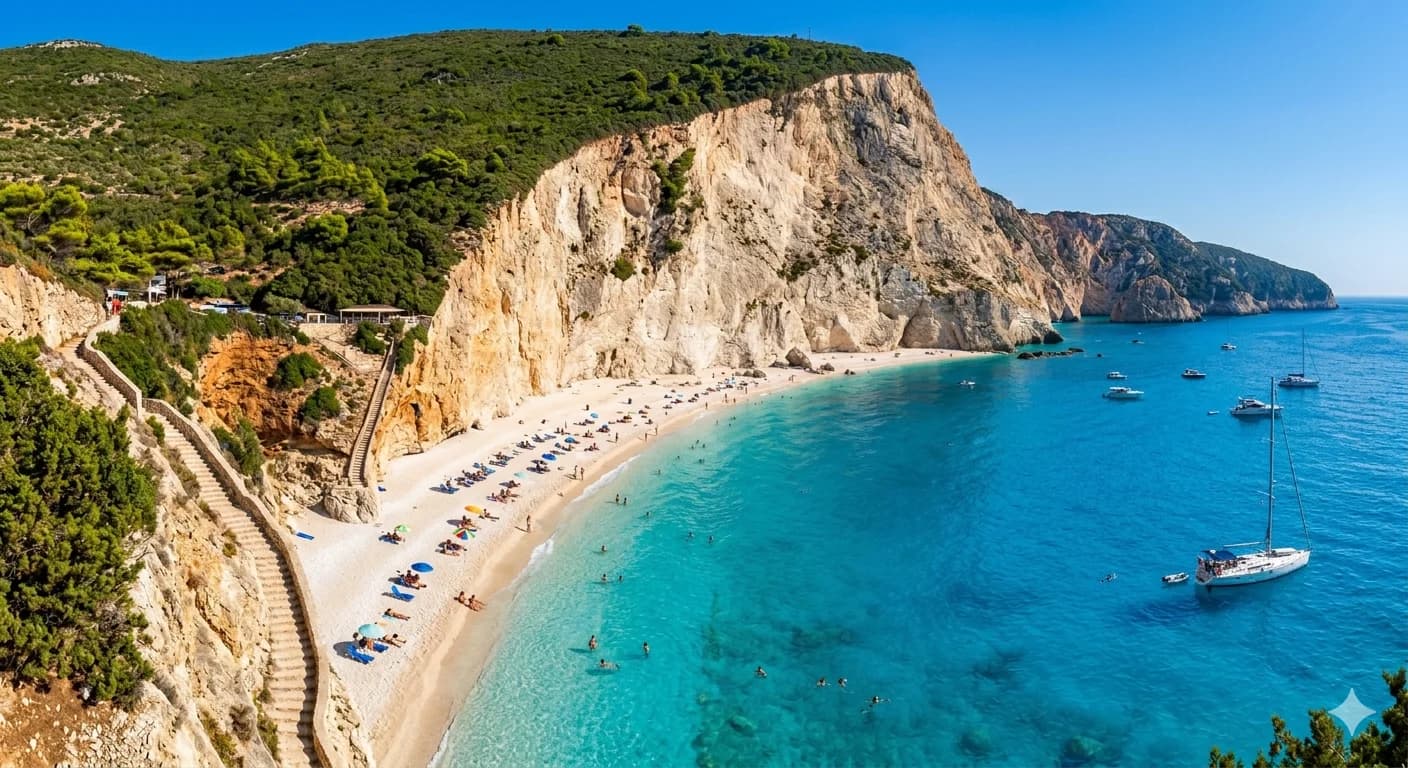
Let's be honest: the ultimate reason you rent a camper for your trip through the Ionian region is the promise of total freedom. The idea that you drive down the road, spot an incredible little bay, and decide: this is where we're staying.
But we also get asked a lot: "How does this actually work legally in Greece? Can you just park anywhere, or will you get moved along in the middle of the night?"
There are a lot of wild stories floating around online, so we looked into it. Now that the Greek authorities and police (Astynomia) have officially clarified the rules, there's finally good news. Once you know how the game works, traveling by camper here is a dream. Here's our honest advice and everything you need to know about overnight stays.
What changed in the law during 2025
Two pieces of legislation put the rules on paper in 2025. Together they confirm what police were already enforcing in practice — but it's worth knowing the actual source.
Law 5170/2025
Amended the tourism framework law (4276/2014) to explicitly ban pitching tents or parking caravans, motorhomes and trailers on beaches, archaeological sites, the edges of public forests, and other public land, and limits private landowners to hosting one motorhome for free.
Law 5209/2025 — the new Traffic Code
In force since 1 July 2025, this is what actually settled the parking-versus-camping question: motorhomes and campers are treated as ordinary passenger vehicles, and standard Traffic Code parking rules apply as long as no equipment — awning, chairs, tables — is set up outside the vehicle.
Reported fines vary by source — on-the-spot fines in the region of €300 are commonly cited for illegal camping, with steeper penalties for ignoring a police eviction order or camping inside a protected area such as a Natura 2000 site. Enforcement is a local matter, so treat any figure as indicative rather than fixed.
Parking is fine, camping is a different story
The whole secret to stress-free travel in Greece comes down to two words: parking versus camping.
Under Greek traffic law, a camper is simply a vehicle. So in principle you can park it anywhere a regular car is allowed to. And because our Ionian Nomads fleet is made up of compact campers (well under the legal 7.5-metre limit), you get a huge advantage: you can park inside and outside built-up areas with no time limit. You're also allowed to sleep in it. At that point, your camper is your mobile hotel room.
So when does parking turn into 'camping'?
It's quite simple: as soon as you put things outside the camper that touch the ground. The moment the awning comes out, the folding chairs go up, or the barbecue gets lit on a public parking lot or roadside, the police consider it illegal wild camping. And that comes with hefty fines (€300 or more).
Our golden rule:
Keep it discreet in public spots. Sleep comfortably inside, keep your gear inside, and never leave any trash behind. Do that and you're 100% in the clear for a lovely, quiet night.
| What you're doing | Parking (legal) | Wild camping (restricted) |
|---|---|---|
| Sleeping inside the van | Allowed, no time limit | — |
| Awning, chairs or BBQ outside | Not part of parking | Treated as illegal camping |
| Where it's allowed | Anywhere a car may legally park | Official campsites or with owner permission only |
| Risk of a fine | None, if parked like a normal vehicle | €300 or more |
The three best ways to spend the night
You really don't have to stay "inside" every night. To experience the real outdoor life — chairs out and a cold drink under the awning — we recommend mixing up your trip:
1. Taverna hospitality (our absolute favorite)
The Greeks are famous for their Philoxenia (hospitality). If you settle in at a cozy local waterside taverna in the late afternoon for a good meal, feel free to ask the owner if you can stay on their grounds for the night. Private landowners are allowed to host campers. In exchange for a pleasant evening and a good dinner, nine times out of ten you'll end up in the most idyllic, safe spots right by the sea. And yes, you can put your chairs outside!
2. Charming, small-scale campsites
Don't expect huge mega-campsites with entertainment teams in the Ionian region — instead you'll find cozy, family-run spots. Often right on the beach, tucked away under olive or eucalyptus trees (like on Lefkada or Kefalonia). This is perfect for the hot summer days: plug the camper into shore power, extend the awning as far as you like, and enjoy a warm shower. You'll also increasingly find handy, automated 'Camper Stops' across Greece for a quick overnight stop.
3. The wild outdoors (with a bit of common sense)
Want to really seek out the quiet inland or at a remote bay? You can, as long as you stay away from official beaches, dunes, forests, and archaeological sites — those are strictly monitored by the police. Look instead for a quiet parking spot or an open area inland.
A few of our favorite serviced campsites
Camping Kariotes (Lefkada)
2 km from Lefkada town, right by the water, with a pool on site.
Poros Beach Camping (Lefkada)
On the island's south coast near Mikros Gialos — one of Greece's oldest campsites, steps from the beach.
Dessimi Beach Camping (Lefkada)
On the sheltered east-coast bay you'll pass on Day 2 of our 7-day itinerary.
Camping Sofas (Sivota, Thesprotia)
A mainland option on its own pebble beach near the Sivota bay area.
Camping Nissos (Kastrosikia, Preveza)
The closest to Aktion Airport — set in an olive grove with direct beach access.
What enforcement actually feels like in Western Greece
The rules on paper are one thing — what you'll actually experience on the Ionian coast is another, and it's genuinely more relaxed than the headlines suggest.
- Police rarely bother quiet overnight parkers. If you're clean, quiet, and out of the way, you're unlikely to have any interaction at all.
- Locals are welcoming. Western Greece has a hospitality culture that extends to travelers — a smile and a "kalimera" go a long way.
- Beach enforcement is the exception. Parking directly on sand or a beach access road is the one thing that reliably draws attention and fines.
- Peak season brings more patrols. July and August see more municipal checks, especially around Lefkada and Sivota; May–June and September–October are noticeably quieter.
- Protected areas are non-negotiable. Natura 2000 sites, archaeological zones, and nature reserves are properly enforced — respect the signs.
The golden rules, no matter what the law says
These are the habits that actually keep you welcome on the road — for your own safety, the environment, and every camper who comes after you:
- Leave no trace. Every wrapper, every cigarette butt, every drop of grey water — take it all with you.
- Keep it quiet after 10pm. No generators, no loud music, no slamming doors.
- Never on beaches. Not on the sand, not on the access road to the sand.
- Never block roads or access. Emergency vehicles, fishing boats, and farm equipment need to get through.
- One night, then move on. Better manners, and there's too much of Western Greece left to see.
- Respect signs and barriers. If it says no parking, no entry, or private — believe it.
- Use your cassette toilet properly. Never dump waste in nature; use campsite facilities or designated points.
- Take wildfire risk seriously. No open fires, no barbecues on dry ground, no exceptions in summer.
Our favorite apps on the road
You really don't need to plan your route day by day in advance. This is how we — and most experienced vanlifers — find spots on the go:
Park4Night
The absolute bible for camper travelers. Community-reviewed spots with photos, GPS coordinates, and practical details like noise level and shade. Read reviews from the last few months — enforcement and access can shift season to season.
Campercontact / iOverlander
Super handy for quickly finding official service points where you can fill up with clean water and dispose of your wastewater properly, and popular with longer-distance overlanders for more remote spots.
Google Maps satellite view
Old-school but effective. Zoom in on the coast for pullovers, dead-end tracks, and flat ground near the water, then cross-check what you find against Park4Night reviews.
Local knowledge
Still the best source of all. Taverna owners, petrol station attendants, and other vanlifers on the road will point you to spots that never make it into any app.
Fully self-sufficient on the road
Because flexibility is everything, we've fitted our campers so you can travel completely independently (self-contained). Thanks to the built-in solar panels, a good fridge, and generous water tanks, you can comfortably go off-grid for a few days without needing a power hookup. Combine that with the compact size of the van, and you hold the key to the ultimate Greek adventure.
Disclaimer: This is practical travel guidance only, not legal advice. Local enforcement and rules can vary and change over time.