Destination Guide · 28 September 2026 · 10 min read
The complete Ioannina travel guide: castle, lake island and Ali Pasha's old capital
A lakeside citadel, a monastery island reached by boat, a 600-year silversmithing tradition and a genuinely dark chapter of Ottoman-era history — Epirus's capital deserves more than a fuel stop on the way to the mountains.
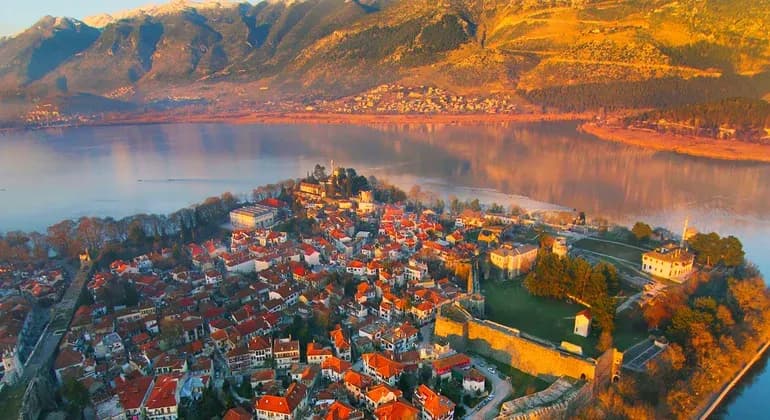
Most campervan itineraries treat Ioannina as a waypoint — the town you pass through on the E55 between the coast and the stone villages of Zagori. That undersells it. Ioannina is a genuine city with a walled old town on a lake, a fortress that was once the seat of one of the Ottoman Empire's most notorious regional rulers, and an inhabited island reached only by boat.
This guide treats Ioannina as a destination in its own right, whether you stop for an afternoon or stay the night before heading up into the mountains. If you're planning the Zagori and Vikos Gorge leg of your trip, our Zagori & Vikos Gorge guide picks up exactly where this one leaves off.
Ioannina at a glance
Ioannina (also spelled Ioánnina, sometimes anglicised as Yannina or Janina) is the capital of the Epirus region in northwestern Greece, built on the western shore of Lake Pamvotida at around 500 metres elevation. The city itself had a population of roughly 65,000 at the 2021 census, with close to 114,000 across the wider municipality — a proper city by the standards of this coast, with real restaurants, a university, and accommodation options well beyond the campsites and studios found further south.
Founded by the Byzantine emperor Justinian in the 6th century, Ioannina grew in importance after the Fourth Crusade in 1204, when wealthy Byzantine families fled here following the fall of Constantinople. It fell to the Ottomans in 1430 and, from 1788, became the capital of the semi-independent pashalik ruled by Ali Pasha — the period that shaped most of what visitors come to see today.
- A walled old town built on a lake, with a fortress you can walk into and around
- Nisi, an inhabited lake island reached only by a short ferry — no bridge or road
- A silversmithing tradition documented since the 15th century, still practised today
- A genuine city with hotels, restaurants and nightlife, not just a day-trip stop
- The natural gateway to the Zagori villages and Vikos Gorge, roughly an hour further north
Getting there from PVK
Ioannina sits roughly 100km from Preveza/Aktion Airport (PVK), and the drive takes around 1.5 to 2 hours by campervan — north on the E55, following the Ambracian Gulf coast before climbing inland through green hills toward the city. The road is fast, well-paved dual carriageway for almost the entire route.
If you're continuing on to the Zagori villages afterwards, our Zagori & Vikos Gorge guide quotes roughly 3 hours from PVK to villages like Monodendri or Papigo — Ioannina sits comfortably inside that drive, roughly two-thirds of the way there, which makes it a natural stop rather than a diversion.
There's no motorway toll on this stretch — like the rest of the E55 route north from PVK, you're on the free national road the whole way.
Ioannina Castle (Its Kale): the old town's citadel
The Castle of Ioannina is the oldest continuously inhabited Byzantine castle in Greece, originally built under Emperor Justinian in the 6th century. It reached its final form under Ali Pasha in the late 18th and early 19th centuries, who fortified it heavily and built his palace within its walls during his decades ruling the region.
Within the castle's outer walls sits Its Kale, a separate, more tightly walled inner citadel in the southeastern corner — this is where most of the sights below are concentrated, and where Ali Pasha's residence, mosque and tomb once stood.
The Fethiye Mosque and Ali Pasha's tomb
Ali Pasha is buried in a cast-iron tomb beside the Fethiye Mosque inside Its Kale. The mosque itself dates to the Ottoman period and is one of the citadel's most recognisable landmarks.
Byzantine Museum
Housed on the site of Ali Pasha's former residence (serai), the Byzantine Museum covers the region's Byzantine and post-Byzantine history, with a treasury annexe displaying ecclesiastical silverwork and coins.
Silversmithing Museum
Set into the old western rampart and former castle kitchens of Its Kale, this museum traces Ioannina's silverworking tradition — documented as far back as the 15th century — through tools, techniques and finished pieces once exported as far as Venice and Vienna.
Ethnographic (Folklore) Museum
Housed in the 17th-century Aslan Pasha Mosque, this small museum covers the city's Christian, Muslim and Jewish communities side by side — costumes, photographs, religious objects and documents that trace Ioannina's genuinely mixed history.
Lake Pamvotida and Nisi, the lake island
Lake Pamvotida borders the old town on three sides, and at its centre sits Nisi — an inhabited island with no official name of its own (locals just call it Nisi, "the island", or Nisaki, "the little island"). It's reached by a short ferry crossing of about 10 minutes from the quay near Mavili Square, with boats running roughly twice an hour.
The island holds seven monasteries, once a significant monastic community and today mostly run as small museums. The most historically loaded stop is the Monastery of Agios Panteleimonas, where Ali Pasha was killed by Ottoman forces in January 1822 after taking refuge there — the room where it happened survives, and now houses the Museum of the Pre-Revolutionary Period, displaying artefacts connected to Ali Pasha and the Ottoman-era history of Epirus. The Monastery of Filanthropinon is also worth seeking out for its well-preserved wall paintings.
Nisi's handful of lakeside tavernas are known specifically for lake fish and eel — a genuinely different food experience from the coastal seafood further south, and one reason locals make the crossing even without the history. Budget an hour or two to see the monasteries and grab a meal, or make a half-day of it if you want to walk the island's quiet lanes properly.
Who was Ali Pasha?
Ali Pasha of Tepelena (1740–1822) was an Ottoman-appointed pasha who, from 1788, ruled Ioannina and, over time, a much larger semi-independent territory covering parts of what's now Albania, Epirus and western Thessaly, known as the Pashalik of Yanina. He answered nominally to the Sultan in Constantinople but ran his court with real independence, playing Ottoman, French and British interests off one another as it suited him.
His court in Ioannina became famous across Europe, drawing Western travellers and diplomats — Lord Byron visited in 1809 and wrote about him at length in Childe Harold's Pilgrimage. Ali Pasha's reputation is a genuinely mixed one: a ruthless and often brutal ruler by most contemporary and historical accounts, but also a capable administrator whose court made Ioannina one of the most important cities in the Ottoman Balkans.
His rule ended in 1822, when the Sultan moved against him for acting too independently. He retreated to the monastery on Nisi island, and was killed there by Ottoman forces — the event that the Museum of the Pre-Revolutionary Period on the island now commemorates. His death came just as the Greek War of Independence was gathering pace elsewhere in the country.
Beyond the old town
Archaeological Museum of Ioannina
Set beside Litharitsia Park a short walk from the old town, this museum covers northwestern Greece from prehistory through the Roman era, with a strong collection of finds from the ancient oracle site of Dodoni nearby.
Perama Cave
One of Greece's largest show caves, about 5km from central Ioannina on the far side of the lake — easily reached by car or local bus. Guided tours run roughly every hour through around 1.5km of passages lined with stalactites and stalagmites; it's a genuinely worthwhile half-day add-on rather than a separate trip, and a good option on a hot afternoon since the cave stays a constant, cool temperature year-round.
The old bazaar and pedestrian old town
The streets around the castle's outer walls are lined with old Ottoman-era buildings, silversmith workshops and small tavernas — a good place to wander in the evening once the day-trip crowds have thinned out.
Food and drink
Ioannina and the wider Epirus region have a distinct food culture built around lake fish and an outstanding savoury-pie tradition.
Pites (Epirote pies)
Epirus is famous across Greece for its savoury pies — thin, hand-stretched phyllo filled with wild greens (hortopita), local cheese (tiropita), or seasoned meat (kreatopita). Look for them at bakeries and tavernas throughout the old town.
Lake fish, eel and frog legs
Thanks to Lake Pamvotida, Ioannina's menus include dishes rarely seen elsewhere in Western Greece — trout, carp, smoked or grilled eel, and frog legs, usually served simply with lemon and herbs. The tavernas on Nisi island are the traditional place to try them.
Local dairy and meze
Epirus produces good local cheeses and yoghurt, often served as part of a wider meze spread alongside the pies — a good way to sample several things without committing to one dish.
Where to stay
Unlike most destinations on this site, Ioannina is a proper city with a full range of accommodation — hotels inside and around the old town, mid-range chains near the lake, and everything in between. A short overnight stay works well if you want to see the castle sights and the island properly without rushing, or as a base for a Zagori day trip before pushing on with your route.
There's no dedicated campsite in central Ioannina itself, so if you're travelling in a campervan and want to stay overnight in the area, most people either use it as a day stop on the way to or from Zagori (where informal parking near Monodendri and Papigo is more common, and covered in our Zagori guide) or find a hotel car park for the night if they want the old town on their doorstep.
Best time to visit
Ioannina has a genuine four-season climate — cooler and wetter than the coast, given its inland, elevated position — so the best time to visit depends on what else is on your route.
| Period | What to expect | Verdict |
|---|---|---|
| April–May | Mild days, the lake and surrounding hills at their greenest | Good for combining with early-season Zagori hiking |
| June–August | Warm to hot, busiest with domestic tourism and university-linked events | Fine for the city sights; the castle and museums offer welcome shade |
| September–October | Warm days, cooler evenings, crowds easing | Arguably the best all-round window, especially paired with Zagori's autumn colours |
| November–March | Cold, occasional snow, shorter museum hours | Workable as a city stop, but not the season for lake boat trips or Zagori |
Our pick: May or September–October — mild enough to enjoy the castle and the island on foot, and the best pairing with a Zagori leg either side of your Ioannina stop.
Ioannina as the gateway to Zagori
Almost every route into the Zagori villages and the Vikos Gorge passes through or around Ioannina, which makes it the natural place to break your journey — whether that's a coffee stop, an afternoon at the castle, or an overnight stay before heading into the mountains. Our Zagori & Vikos Gorge guide covers the drive onward and the villages themselves, our Vikos Gorge hiking guide covers the trail options in detail, and our guides to the Voidomatis river, Papigo's natural pools and the stone bridges of Zagori cover specific sights within the region.
If your route continues further east, Ioannina also sits within reach of Meteora — our Meteora from Western Greece guide covers both driving options from PVK in detail, one of which runs through this part of Epirus.
Practical tips
- The ferry to Nisi runs from the quay near Mavili Square, roughly twice an hour — no need to book, just turn up and pay the small crossing fee.
- Its Kale's museums keep separate hours and, in some cases, close on different days — check current times locally rather than assuming they match, since our own research turned up inconsistent hours across sources.
- Parking is easier around the lake promenade than in the narrow streets of the old town itself — leave your vehicle there and walk in.
- Pack a light layer even in summer if you're heading up to Zagori afterwards — Ioannina's elevation and lake setting already run cooler than the coast, and the mountains beyond are cooler still.
- Cash is useful on Nisi island, where some of the smaller tavernas and museum entrances don't take cards.
Keep planning your trip
- Zagori & Vikos Gorge from PVK: a campervan day trip or weekend
- Vikos Gorge hiking guide: from an easy viewpoint to the full crossing
- The Voidomatis river: the Ice Age Trail, swimming spots and rafting
- Papigo's natural pools: cold, clear and carved into the mountain
- The stone bridges of Zagori: a walking guide through history
- Driving to the Meteora monasteries from Aktion Airport, the scenic way
- Browse our campervan fleet
Planning your route through Epirus?
Whether Ioannina is a lunch stop or an overnight base before Zagori, Aktion Airport gets you into a campervan within an hour of landing — browse our fleet to find the right van for the mountain roads ahead.
Join the Waitlist