Route Guide · 6 August 2026 · 9 min read
Driving to the Meteora monasteries from Aktion Airport, the scenic way
Skip the Athens motorway grind. The western approach to Meteora crosses Greece's most dramatic inland scenery — lakes, gorges and mountain villages — in around three hours.
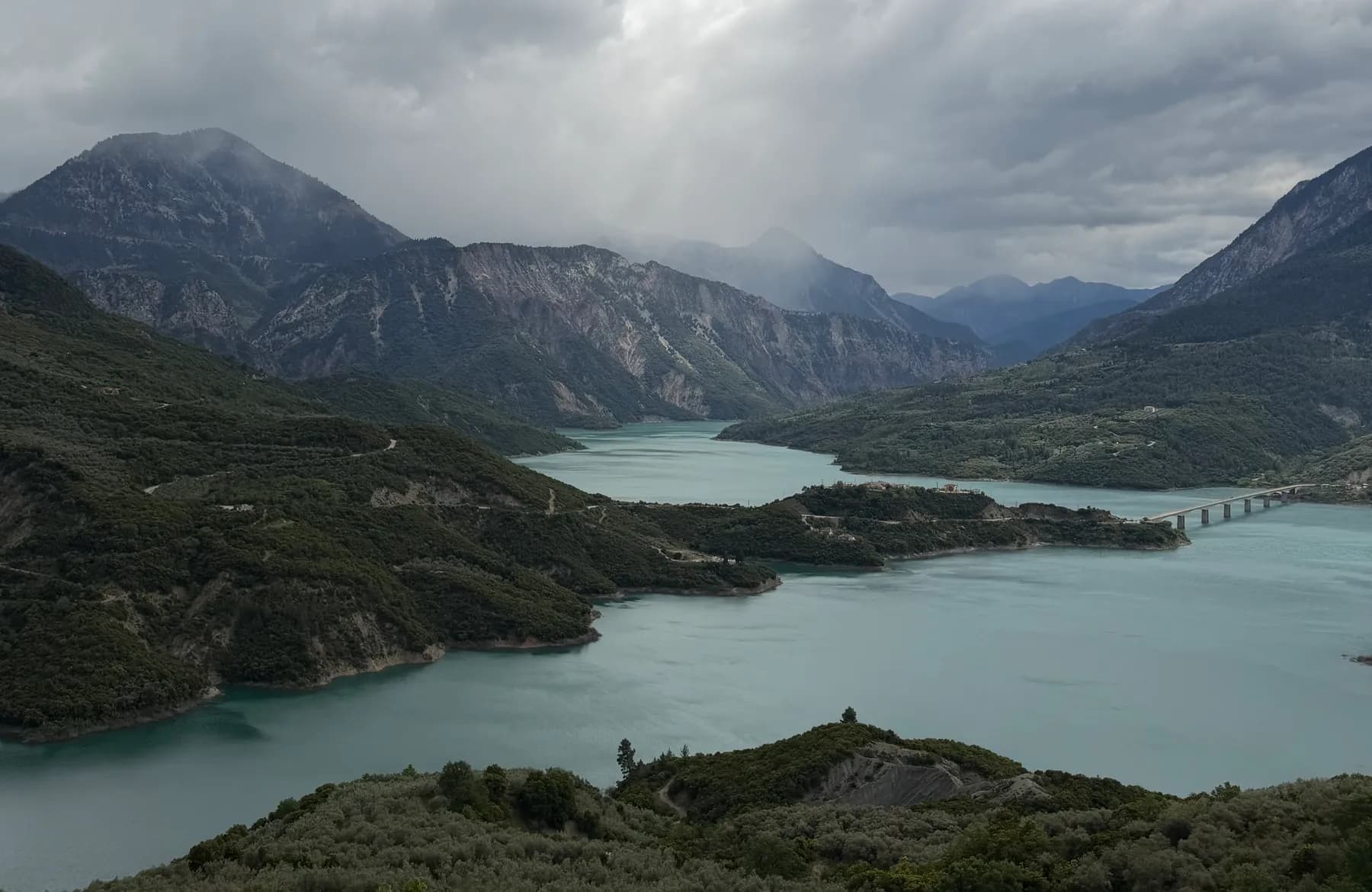
Search "how to get to Meteora" and you'll find the same advice everywhere: drive from Athens, or come down from Thessaloniki. Both work, and both are mostly motorway with little to look at until the rock pillars appear on the horizon.
The western approach gets far less attention. Starting from Aktion Airport (PVK), you can reach the monasteries in roughly three hours, crossing Greece's largest artificial lake and climbing through mountain villages along the way. If you're already exploring Western Greece by campervan, Meteora isn't a detour — it's the natural next chapter.
Two routes, one destination
From PVK you have two realistic ways to reach Kalambaka, the gateway town for Meteora. Both take roughly three hours, with quite different characters.
The mountain route (via Agrinio & Karpenisi)
About 4.5–5.5 hours · Roughly 300 km
The scenic option. From PVK, drive east along the coast through Vonitsa and Amfilochia to Agrinio, then climb north-east on the national road toward Karpenisi, crossing the Episkopi Bridge over Lake Kremasta — Greece's largest artificial reservoir. Beyond Kremasta, the road enters the mountainous Agrafa region before reaching Karpenisi and continuing to Trikala and Kalambaka. This is a proper mountain road — single carriageway, plenty of curves — manageable in a campervan but worth taking at an easy pace, especially in a larger vehicle.
The fast route (via Arta & Trikala)
About 2.5–3 hours · Roughly 190 km
From PVK, head north toward Preveza and on to Arta — worth a coffee stop for its medieval bridge — then east toward Trikala on flatter, faster roads, and up to Kalambaka in the final 20 minutes.
Our recommendation: take the fast route via Arta on the way there, and return through Karpenisi and Kremasta — different scenery both ways, and you arrive at Meteora with energy left to explore.
The six monasteries: the practical version
All six monasteries are open to visitors, but each closes on a different day of the week, and hours shorten outside the April–October season — so you need at least two days if you want a shot at all of them.
| Monastery | Typically closed on | Notable for |
|---|---|---|
| Great Meteoron | Tuesdays | The largest, with the best museum and 300+ steps |
| Varlaam | Fridays | Beautiful frescoes and a rope-and-basket pulley display |
| Roussanou | Wednesdays | The most photogenic, an active nunnery, strong sunset views |
| Holy Trinity | Thursdays | A James Bond filming location, 140 carved steps |
| St Stephen's | Mondays | Easiest access via a bridge with no steps, panoramic terrace |
| St Nicholas Anapausas | Fridays | The smallest, with exceptional 16th-century frescoes |
Closure days and hours are set by the monasteries themselves and can change without notice — check the current schedule before you plan your day around a specific one.
Entry is €5 per person per monastery, payable in cash at each entrance — there's no single combined ticket, so visiting all six runs to around €30 per person.
Shoulders must be covered and sleeveless tops aren't allowed for anyone. Women need a long skirt below the knee — trousers don't count, though most monasteries lend a wrap-around skirt at the entrance. Men need long trousers: shorts of any length aren't permitted, and there's no loaner option for men, so plan your outfit before you go.
Campervan parking at Meteora
Each monastery has a designated parking area, but space is limited and the larger lots (Great Meteoron, Varlaam) fill up by mid-morning in season. A one-way loop road connects all six, starting from Kalambaka and climbing through Kastraki — paved, with tight curves and the occasional tour bus, but manageable in a standard campervan.
If your vehicle is significantly taller or longer than a standard campervan, park in Kalambaka or Kastraki and take a taxi or the local bus up to the monasteries rather than risk a tight access road or low-hanging rock formation.
Where to park overnight
Kastraki, at the base of the rocks, is the quieter of the two gateway villages and the better base.
Meteora Garden Campsite (Kastraki)
A year-round campsite on the edge of Kastraki with direct views of the rock pillars, pitches for campervans, Wi-Fi and a restaurant. Confirm current rates directly, as pricing varies by season.
Kalambaka
The larger, busier of the two towns, with more services and shops if you need to restock before or after your visit.
Why this route beats the Athens approach
Most visitors drive from Athens because it's the default. The western approach from PVK compares well in several ways:
- It's comparable in time, or shorter — around three hours via Arta, similar to or faster than the roughly four-and-a-half-hour drive from Athens.
- The drive is part of the experience — Lake Kremasta and the Agrafa mountains, rather than motorway service stations.
- If you're already exploring Lefkada or the Ionian coast, Meteora is a natural extension rather than a separate side trip requiring a trip back to Athens.
- Arriving from the west puts you into Kastraki first, the quieter of the two gateway villages.
Making it a two-day trip
Day 1
Leave your Ionian coast base after breakfast, take the fast route via Arta, and arrive in Kastraki by lunchtime. Settle into your overnight spot and spend the afternoon visiting two or three monasteries, checking in advance which ones are open that day.
Day 2
Start early for the remaining monasteries, drive the full loop road with stops at the viewpoints, and head back via the mountain route through Karpenisi and Lake Kremasta, turning the return journey into a second day of sightseeing.
Planning your route from PVK?
Browse our fleet to find your van, or join the waitlist to lock in your dates for next season.
Join the Waitlist