Destination Guide · 1 September 2026 · 11 min read
The complete guide to Parga, Greece
Colourful houses cascading to a Venetian harbour, some of the clearest water on the Ionian coast, and a mythological river gorge a short drive away — here's everything to know before you go.
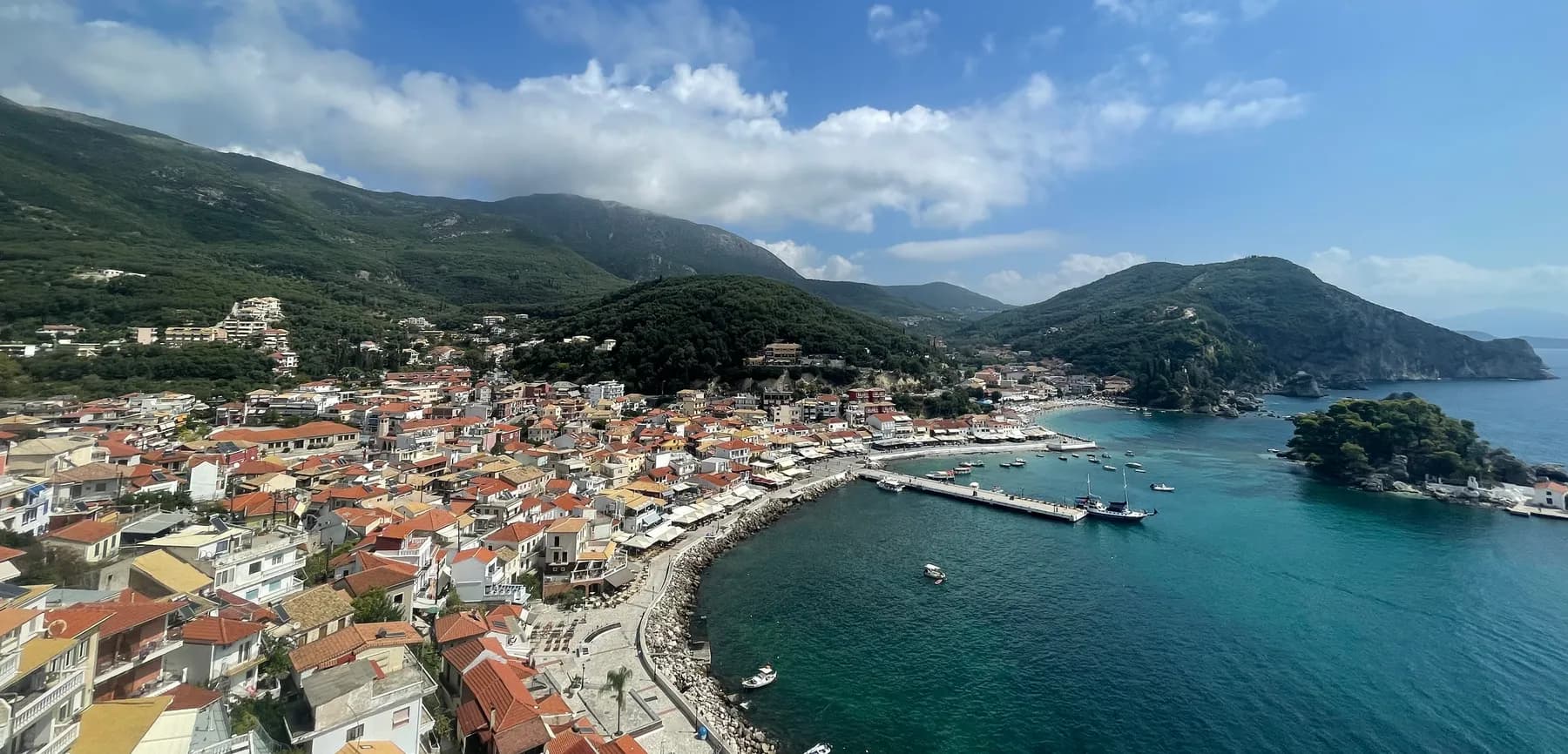
The road from Preveza climbs through olive groves and mountain passes for the best part of an hour, giving nothing away. Then, on one final bend, the hillside opens up and there it is: apricot, terracotta and sun-bleached white houses tumbling down to a harbour, a Venetian castle on the headland above, and a small pine-covered island sitting just offshore.
That first view is the reason Parga has been pulling visitors to this corner of Epirus, in northwestern Greece, for decades — but there's a lot more to the town than a pretty approach road. This guide covers the beaches, the old town, the food, where to stay, and the handful of day trips that make Parga a genuinely good base rather than just a photo stop.
Parga at a glance
Parga is a small coastal town on the Ionian Sea, part of the Epirus region rather than one of the Ionian islands proper — though the colourful, stacked architecture along the harbour has more than a little in common with Corfu's old town. It sits roughly midway between Preveza and Igoumenitsa, backed by green hills and olive groves rather than the bare limestone you'll find further south.
What makes it worth the detour is how much sits within a short walk or drive of each other: a medieval castle above the old town, three distinct beaches within a few kilometres, the mythological Acheron River gorge inland, and a working harbour where the fish on your plate was very likely swimming that morning.
Three days is enough to see the old town, swim at the main beaches and fit in one day trip. Five days gives you room to find a favourite taverna and add the Acheron gorge or a boat trip to Antipaxos without rushing.
How to get there
By air, via Aktion Airport (PVK)
The nearest airport is Aktion Airport (PVK), also listed as Preveza or Lefkada airport depending on the booking site. It has seasonal charter and low-cost routes from the UK, Germany, the Netherlands and several other European countries, mostly running from May to October.
From PVK, Parga is around 65–70km away, and the drive typically takes a little over an hour depending on the route and traffic. There's no direct public bus from the airport, so most visitors rent a car, book a private transfer, or take a taxi.
By ferry, via Igoumenitsa
If you're arriving from Italy or Corfu, Igoumenitsa is the main port, with regular ferry connections from Ancona, Bari, Brindisi and Venice, plus Corfu town. From Igoumenitsa, Parga is about 45km south along a coastal road — well under an hour's drive.
For the full ferry schedule and what to expect bringing your own vehicle across the Adriatic, see our dedicated guide to the ferry crossing from Italy to Igoumenitsa.
By car
Driving from Athens takes around four and a half hours via the Ionia Odos motorway, with tolls that can add up to somewhere in the €35–40 range one way depending on your exact route — worth checking current pricing before you set off, since Greek toll rates are revised periodically. From Thessaloniki, expect a similar four-hour-plus drive.
If you're exploring more of the Ionian coast, having your own vehicle — or a campervan — makes the beaches and day trips around Parga far easier to reach on your own schedule.
The best beaches
Parga's beaches are the main event, and the water here is genuinely some of the clearest on this stretch of coast.
Valtos beach
The big one: a long, gently curved stretch of sand and fine pebble on the western side of the headland. Drive there directly (parking fills up early in summer) or take the small water taxi from the harbour, which is a pleasant ride in its own right. It's family-friendly with plenty of sunbeds, but there's enough length to it that you can walk to a quieter stretch.
Lichnos beach
A cove about 3km south of Parga, framed by limestone cliffs and dense greenery, with sheltered, almost impossibly clear water — bring a snorkel if you have one. There's a signed turning off the main road with a paid parking area and a short walk down to the sand.
Sarakiniko beach
A smaller beach on the northern side of the harbour, reachable on foot from the old town (about ten minutes, with some steps) or by water taxi. Named after the Saracen pirates who once used the cove for shelter, it feels more tucked-away than Valtos or Lichnos and is a good pick if you're after something calmer.
Also worth knowing
- Kryoneri: The town beach, right on Parga's waterfront — small, but handy for a quick dip between sightseeing.
- Ai Giannakis: A quieter, pebbly cove north of town, best reached if you have your own car.
- Agios Sostis (Ammoudia): About 15 minutes south near the mouth of the Acheron River — long, sandy and noticeably less crowded than the town beaches.
Things to do
The Castle of Parga
The castle occupies the forested headland between the harbour and Valtos beach, its present form largely the result of an 18th-century rebuild, though the site was fortified long before that. It's a fifteen-minute climb up through the old town's lanes, steep but short, and it's free to walk the grounds. Go in the late afternoon for the best light over the harbour and out towards Paxos.
The old town
Small enough that you genuinely can't get lost, Parga's old town is a tangle of narrow stone lanes between Venetian-era houses in warm pastel colours. There's no set route — just wander, duck into the small churches, and stop for a coffee in one of the shaded squares.
Boat trips
Small boats run from the harbour throughout the summer: half-day beach-hopping circuits with swimming stops, full-day trips to Paxos and Antipaxos (including the blue caves and Antipaxos's famous Voutoumi beach), and the occasional sunset cruise. Prices vary by operator and season, so it's worth comparing a few kiosks at the harbour before booking rather than going with the first one you see — and in August, book a day ahead for Paxos/Antipaxos.
The Acheron River
About half an hour southeast of Parga, the Acheron — the river identified with the mythological Styx, gateway to the underworld — cuts through a gorge that's become one of the best outdoor half-days in this part of Greece: wading and swimming through cold, spring-fed water, with easy sections for kayaking further downstream. It's detailed enough to deserve its own write-up, so see our full guide to trekking the Acheron gorge for routes, what to bring and how to organise a guide if you want one.
The Nekromanteion of Acheron
Near the village of Mesopotamos, about 25 minutes from Parga, this archaeological site was identified by mid-20th-century excavators as an ancient oracle of the dead, where pilgrims believed they could communicate with departed souls — the remains are modest but genuinely atmospheric, especially after walking the gorge. It's worth knowing that some archaeologists have since argued the site may instead have been a fortified Hellenistic-era farmstead rather than a religious sanctuary; the identification is still debated, though it hasn't dented the site's popularity or its reputation as one of the more evocative ruins in the region. A small on-site museum covers the history and the debate. Allow about an hour.
The island in the bay
The small pine-covered island facing Parga's harbour is known as Panagia, after the whitewashed chapel at its centre. French troops fortified it in 1797, and you can still make out the old walls from the waterfront; it later passed through British and Ottoman hands along with the rest of Parga during the early 19th century, when Ali Pasha of Ioannina controlled the wider region and expanded the main castle above the town. Confident swimmers sometimes make the crossing from Kryoneri beach, and some boat trips include a stop.
Where to eat
Parga is a genuinely good eating town. The waterfront tavernas charge a little more for the view, but the quality holds up well across the board, and it's worth wandering a block or two back from the harbour for slightly lower prices and more local character.
Fresh fish and seafood
Ask what came in that day — grilled sea bream, sea bass or red mullet is usually excellent, and octopus, grilled or braised, is a local staple.
Epirus pies
The wider Epirus region is known for handmade pies with flaky, paper-thin pastry — look for spanakopita (spinach), tiropita (cheese) or hortopita (wild greens), often sold by the slice.
Meze and small plates
Tzatziki, melitzanosalata (smoky aubergine dip), fried courgette balls and saganaki, shared across the table with a bottle of local white — a reliable way to eat well.
Loukoumades
Fried honey doughnuts, best eaten hot from one of the small dessert stands in the old town.
Lunch tends to be noticeably cheaper than dinner at most places, for portions that are just as generous.
Where to stay
Parga is small enough that almost everywhere is within walking distance of the harbour, so location matters less than you'd think. A hotel or apartment in or around the old town puts you closest to the restaurants and the beach water taxis; some upper-town properties have balconies with genuinely spectacular views over the bay. Valtos beach also has its own cluster of hotels and apartments if you'd rather be right on the sand.
Book ahead for July and August — Parga draws a mix of Greek, British and Italian visitors, and the best places sell out months in advance. Self-catering apartments tend to be good value for longer stays.
There are several campsites in the hills around Parga, particularly along the roads to Lichnos and Valtos, ranging from basic to well-equipped with pools. It's a workable base if you're travelling by campervan — just note that driving a larger vehicle into the old town itself isn't practical, so plan to park on the outskirts and walk in. For a fuller rundown of campsites across the wider region, see our guide to the best campsites in Western Greece.
Nightlife and evening atmosphere
Parga isn't really a party town, and that's part of its appeal. What it does well is the evening promenade: as the sun drops, the waterfront fills with families out for a stroll and couples claiming harbour-side tables, and the whole town settles into a warm, unhurried rhythm.
Cocktail bars are scattered along the waterfront and up into the old town, several with harbour-view terraces — lively without being loud. In July and August there's usually a small night market in the old town with local crafts and live music. For anything closer to a club scene, you'd need to head to Preveza or Lefkada.
Best time to visit
May–June
Warm, sunny and noticeably quieter, with the sea swimmable by late May. Our pick for a relaxed visit.
July–August
Peak season: hot, busy and lively, with accommodation prices at their highest. Book well ahead if you're travelling in this window.
September–early October
The sea is at its warmest and the crowds thin out noticeably — arguably the best all-round stretch to visit.
November–April
Many businesses close for the winter and the town is quiet. Fine for a passing stop if you're in the area, but not a beach holiday.
Practical tips
Parking
Space in the town centre is very limited in summer. Use the main car park on the outskirts and walk in — around ten minutes — and get to the beaches before 10am if you're driving.
Cash and card
Most restaurants and shops take cards, but keep some cash for smaller tavernas, sunbed rentals and water taxis. ATMs line the main waterfront street.
Footwear
The old town is hilly with steps and uneven stone — flip-flops are fine for the waterfront, but bring proper shoes for the castle and the lanes above the harbour.
Boat tickets
Buy directly from the operators' kiosks at the harbour rather than through your accommodation, and compare a couple of prices before committing.
Language
English is widely spoken in tourist-facing businesses. A few words of Greek — efcharistó (thank you), yasas (hello) — go a long way.
Day trips from Parga
Syvota
A quieter, less developed harbour village around 25km south, known for some of the most striking water colour on this coast and popular half-day boat trips. Our full guide to Syvota by campervan covers the beaches, the harbour and where to stay if you want to linger longer than a day.
The Acheron gorge and the Nekromanteion
Combine a morning of river trekking with an afternoon at the oracle site near Mesopotamos — pack water shoes, a dry bag and a towel, and see the dedicated sections above for the details.
Paxos and Antipaxos
Around two hours offshore by regular boat, faster with a speedboat charter. Paxos has a charming harbour town at Gaios and a string of sea caves; Antipaxos has two of the most photographed beaches in Greece, Voutoumi and Vrika, in water so clear it barely looks real. Day trips run from Parga harbour all summer — bring snorkelling gear.
Preveza
About an hour north, with a long waterfront promenade and a more local, less touristy feel. Worth combining with a visit to Nikopolis, the vast Roman city founded by Emperor Augustus just outside town, and Preveza's small archaeological museum.
Keep planning your trip
- Browse our campervan fleet
- Planning a longer coastal road trip? Our 4-day route from Messolonghi to Parga ends right here
- The Acheron River in full: trekking the mythological river of the underworld
- Bringing your own campervan from Italy: the ferry guide to Igoumenitsa
- Syvota by campervan: the quieter harbour town 25km south
- The 7 best campsites in Western Greece for campervans
- The complete guide to Lefkada
- The Ionian coast loop: Preveza, Parga and Syvota by campervan
- 7 days in Western Greece: the complete campervan itinerary
Planning your own trip to Parga?
A campervan makes it easy to combine Parga with the beaches, gorges and villages around it — browse our fleet and pick one up at Aktion Airport.
Join the Waitlist