Destination Guide · 28 September 2026 · 9 min read
Ithaca: the real island of Odysseus
A small, mountainous island that every telling of Homer's Odyssey names as Odysseus's home — though, as we'll get into, that identification is more debated than most tourist material admits. What isn't debated: there's no airport and no bridge, so getting there starts with a ferry.
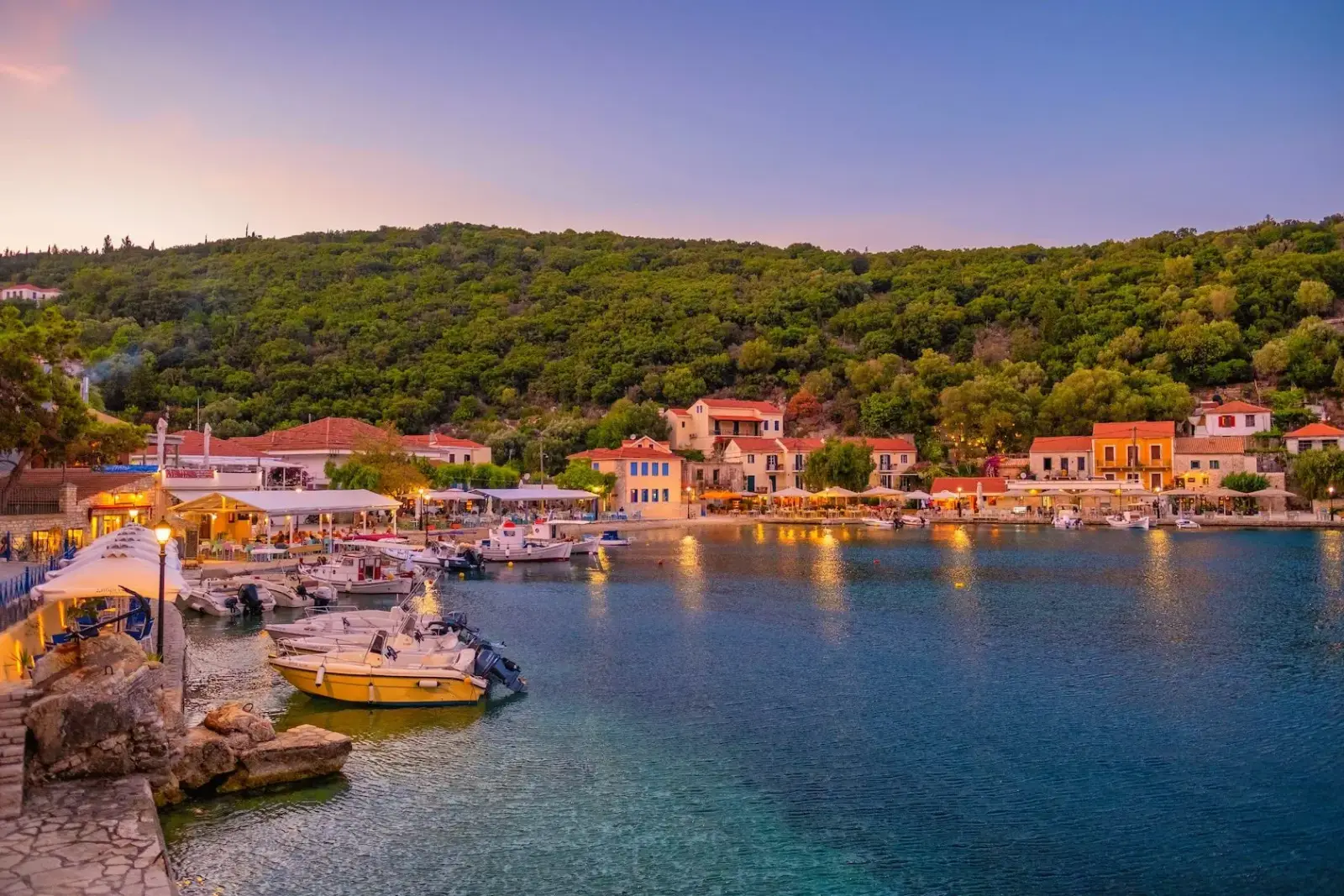
Ithaca (Ithaki) is the island Homer's Odyssey names as Odysseus's home after ten years fighting at Troy and another ten finding his way back. That's the island's whole tourism identity — but it's worth saying upfront that whether the Odyssey's Ithaca and this modern island are actually the same place is a genuine, long-running scholarly debate, not a settled fact. We'll cover that honestly further down.
What's not in doubt is the practical side: Ithaca has no airport and no bridge, so every visit starts with a ferry, and the routes and travel time depend on where you're coming from. This guide covers getting there, the island's three main villages, the Odyssey-linked sites worth seeing (and what's actually been found at them), the beaches, and whether it's realistic as a day trip. Since Ithaca is almost always reached via Kefalonia, our Kefalonia by campervan guide covers that island and the Lefkada–Kefalonia crossing in more depth than we will here.
Ithaca at a glance
Ithaca sits in the Ionian Sea just northeast of Kefalonia, split into two mountainous lobes joined by a narrow isthmus. It's small — around 96 square kilometres — and its own regional unit within the Ionian Islands region, administratively separate from Kefalonia even though the two were grouped together in a single prefecture before Greece's 2011 local government reform and remain closely linked by ferry and by history.
- No airport and no bridge — the island is reached only by ferry
- Small and mountainous: about 96 km², roughly 23km at its longest, in two lobes joined by a narrow isthmus
- Population of around 3,000, concentrated mostly in the capital, Vathy
- Its own regional unit within the Ionian Islands region, separate from Kefalonia's
- Quiet by Ionian standards — largely free of the mass-tourism infrastructure found elsewhere in the islands
How to get to Ithaca: there's no airport, so plan around the ferry
Ithaca has no airport and no road connection to anywhere else — every visit starts with a ferry, and which one depends on where you're coming from.
From Kefalonia (the standard gateway): a short crossing of roughly 20–30 minutes connects Sami, on Kefalonia's east coast, to Piso Aetos, Ithaca's main port, with several sailings a day in summer and a much thinner schedule outside the season. This is the route most visitors use, especially if you've already brought a campervan across from Lefkada to Kefalonia — see our Kefalonia by campervan guide for that crossing.
From the mainland: ferries also run from Astakos (around 2 hours to Frikes, or a bit over 3 hours to Piso Aetos) and from Patras (roughly 4 hours, typically calling at Sami on Kefalonia en route). Both run year-round but with far fewer departures outside summer.
There's no direct ferry from Lefkada to Ithaca — Kefalonia is the standard gateway, so if you're starting from Lefkada, budget for two separate ferry legs rather than one.
As with any Greek island ferry, don't treat a specific schedule, price or operator as fixed here — routes and frequency shift by season and by year, so check current timetables with Kefalonia's ferry operators or the relevant port authority before you travel.
Can you bring a campervan? Cars and small vehicles travel routinely on all three routes, and vehicle fares from Kefalonia are inexpensive. But this is a small-island, small-road destination — Ithaca's lanes are narrow and twisty with steep drops in places, and Piso Aetos itself is little more than a jetty with minimal facilities, not a full-service port. If you're travelling in a larger motorhome, confirm your vehicle's length and height against the ferry operator's limits before booking, and weigh up whether a day visit without the van — leaving it parked on Kefalonia — might suit the roads better than driving it across.
Is this really Odysseus's island? The debate, honestly
Ithaca's entire tourism identity rests on one claim: that this is the island Homer gave to Odysseus. It's worth being upfront that whether that's actually true is a genuine, long-running scholarly debate rather than settled fact.
Most classicists have traditionally accepted that modern Ithaki is the Odyssey's Ithaca, and islanders have identified with the story since antiquity — ancient inscriptions and dedications to Odysseus have turned up here. But some scholars have pointed out that Homer's description doesn't fit the modern island especially well: the poem describes its Ithaca as low-lying and as the westernmost of a cluster of islands, and this Ithaca is mountainous and sits east of Kefalonia, not west of anything. Alternative theories have proposed neighbouring Kefalonia, or even Lefkada — championed in the early 20th century by the archaeologist Wilhelm Dörpfeld — as the "real" Homeric Ithaca instead.
Recent archaeology has added real weight to modern Ithaca's case without fully settling the question. Long-running excavations at Agios Athanasios in the island's north — a site traditionally nicknamed the "School of Homer" — have uncovered a Mycenaean-era complex with roof tiles and inscriptions referencing Odysseus, which the excavating team has interpreted as evidence of an ancient hero cult built around him. That's genuine evidence that ancient people here worshipped Odysseus as a local hero — it isn't proof that a historical Trojan War veteran actually lived on this island, and it doesn't fully resolve the Homeric-geography argument either.
None of that should stop you enjoying the sites — it just recalibrates what you're looking at. Think of it less as a certified birthplace and more as an island that has spent over two thousand years believing, with real archaeological backing, that it's the one Homer meant.
The villages: Vathy, Kioni and Frikes
Vathy (Vathi)
The island's capital and main port, wrapped around one of the most sheltered natural harbours in the Ionian. Much of the town was rebuilt after the devastating 1953 earthquake that flattened large parts of the Ionian Islands, and today it has a waterfront promenade of cafes and tavernas plus the island's only real concentration of shops, banks and services. Ithaca's official ferry port, Piso Aetos, is a fair distance away, so most arrivals connect on to Vathy by bus, taxi or their own vehicle.
Kioni
A small fishing village on the northeast coast, tucked into a narrow inlet and often singled out as one of the prettiest harbours in the Ionian — pastel houses stacked above the water, a handful of tavernas, and a noticeably slower pace than Vathy.
Frikes
The island's other northern harbour village: smaller and more low-key than Kioni, and the arrival point for ferries from Astakos on the mainland. A relaxed base with a short strip of waterfront tavernas rather than a sightseeing destination in its own right.
Odysseus-linked sites: what's actually there
These are real, named sites that tourist material routinely links to the Odyssey — but the strength of that link varies a lot from site to site, so here's what's genuinely been found at each.
Cave of the Nymphs (Marmarospilia)
Near Dexia beach, a short distance from Vathy, this cave is traditionally identified with the one where, in Book 13 of the Odyssey, Odysseus hides the gifts given to him by the Phaeacians. Excavations between 1998 and 2001 found genuine ancient material inside — a small shrine structure, votive offerings, and objects dedicated "to Odysseus" dating as late as the 2nd century BC — confirming it was a real cult site in antiquity. That's evidence of ancient belief, not modern proof that this is the exact cave Homer described, so visit it as the former rather than the latter. The cave itself is modest and can be uneven underfoot.
School of Homer (Agios Athanasios, near Exogi)
A hillside archaeological site in the island's north, excavated on and off since the 19th century and intensively since the early 2000s by a University of Ioannina team. The old nickname comes from a since-abandoned theory that it was literally a school Homer attended; the site's real significance turned out to be different, and arguably more interesting. Findings announced in 2025 — a Mycenaean-era cistern, stamped roof tiles and shrine remains linked by inscription to Odysseus — were presented as evidence of an ancient sanctuary dedicated to him, making this one of the more genuinely significant recent archaeological stories in the Ionian rather than just a photo-op with a nickname.
Arethousa Spring
A spring in the island's rugged south, roughly a 3-hour round-trip walk from Vathy along a rough coastal path. It's traditionally linked to the spring in Odyssey Book 13 where the swineherd Eumaios watered his pigs — though the name "Arethousa" and her story actually come from later legend rather than Homer's original text, so treat the naming as tradition layered on top of the poem rather than something in it. The walk itself, through wild, empty scrubland with sea views, is arguably the more reliable payoff.
Beaches worth the detour
Ithaca isn't a beach-first destination the way some of its neighbours are, but a handful are genuinely worth building time around.
Gidaki
Turquoise water over pebbles and limestone, reachable only by a short boat from Vathy or a roughly 30-minute walk from Skinos — no road access, which keeps it quiet.
Filiatro
The closest organised beach to Vathy: a small pebble bay with clear water. Its size and proximity to town mean it fills up, so aim for early morning or late afternoon.
Sarakiniko
A pine-backed, heart-shaped bay with shallow, family-friendly water, on the road toward Piso Aetos.
Dexia
A calm little beach a short walk from Vathy, right by the Cave of the Nymphs — easy to combine with that site in one outing.
Day trip or overnight? Be realistic about the ferry
It's possible to see Ithaca in a single day from Kefalonia — an early-morning sailing out and a late-afternoon one back leaves enough time to reach Vathy and a beach, since the crossing itself is only 20–30 minutes. But most people who've actually done it recommend against rushing: once you add the transfer from Piso Aetos to anywhere worth seeing, plus a village or two, a single day feels tight rather than relaxed, and there are no night ferries on the Kefalonia–Ithaca route — if you miss your return sailing, you're not getting back that night.
If your schedule allows it, one or two nights lets you see Vathy, reach at least one of the north-coast villages, and walk to a site like the Cave of the Nymphs or Arethousa Spring without watching the clock.
Where to stay
Vathy
The most practical base — most of the island's accommodation, restaurants and services, with easy access to Dexia beach and the Cave of the Nymphs.
Kioni or Frikes
Better if you want a quieter, more scenic base and don't mind being a drive from Vathy's amenities — both suit travellers who aren't working to a tight schedule.
For campervan travellers already exploring Kefalonia, Ithaca works best as an overnight or two-night side trip rather than relocating your whole base — see our Kefalonia by campervan guide for where to leave a larger vehicle and how the wider crossing works.
Best time to visit
Ithaca's small size and thin off-season ferry schedule make timing more important here than on bigger islands.
| Period | What to expect | Verdict |
|---|---|---|
| April–May | Warm days, sea still cool, ferries running but reduced | Quiet, good for walking to the Homeric sites |
| June | Warm, ferry frequency increasing | A good balance of warmth and fewer crowds |
| July–August | Peak heat, the most sailings of the year | Easiest logistically, but book accommodation well ahead |
| September | Warm sea, sailings starting to thin out | Arguably the best all-round month |
| October | Mild, ferry schedule cut back sharply, some businesses close | Check timetables carefully before planning around this month |
Our pick: June or September, for a functioning ferry schedule without peak-August crowds in Vathy's small harbour.
Practical tips
- Piso Aetos, Ithaca's main port, is little more than a jetty with limited facilities — arrange onward transport (bus, taxi or your own vehicle) before you arrive, especially outside summer when connections are thin.
- Carry cash — cards aren't universally accepted at smaller village tavernas and beach canteens.
- Roads are narrow and often unguarded on the drops; take mountain routes slowly, especially near Kioni and Frikes.
- Confirm vehicle length and height limits with the ferry operator in advance if you're travelling with a larger van or motorhome.
- Book accommodation ahead for July and August — the island has a genuinely small number of rooms and no large-scale resort infrastructure to fall back on.
Keep planning your trip
- Kefalonia by campervan: the ferry crossing and what to do once there
- Melissani Cave: the underground lake near Sami
- Drogarati Cave: Kefalonia's cavern near Sami
- Melissani Cave, Kefalonia: the underground lake with the glowing blue water
- Browse our campervan fleet
Planning a trip that includes Ithaca?
Ithaca is a side trip from Kefalonia, not a standalone base — browse our fleet to find a van suited to the ferry crossing and Kefalonia's mountain roads before you hop across.
Join the Waitlist